
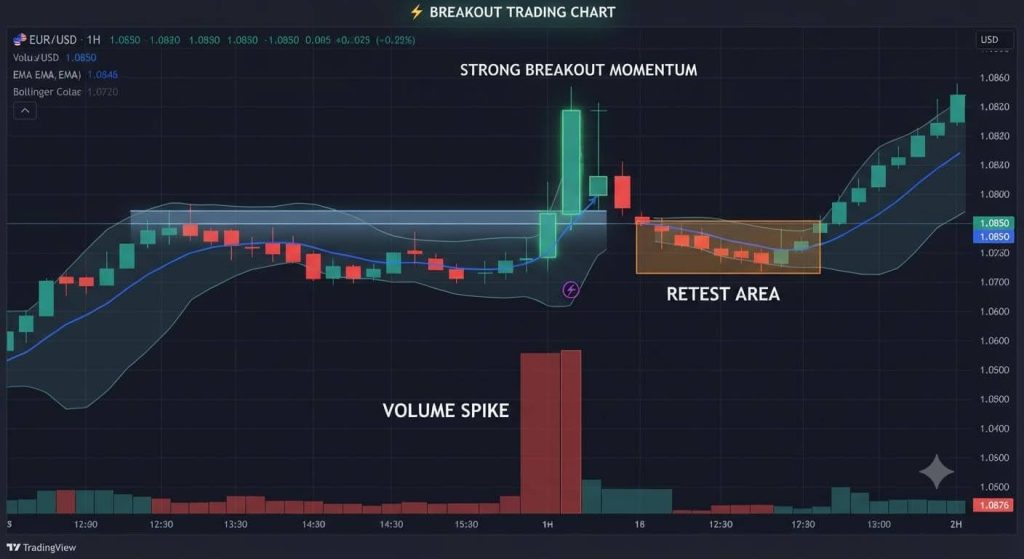
⚡ BREAKOUT TRADING STRATEGY
- Price closes above strong Resistance.
- Increased buying momentum.
- Confirmation with strong bullish candle.
- Confirmation with strong bullish candle.
- Higher trading volume (if available)
- Bearish Breakout
- Price closes below strong Support
- Increased selling momentum.
- Confirmation with strong bearish candle.
- Higher trading volume (if available).
Breakout Confirmation
- Wait for a candle to close outside the level.
- Look for a retest of the broken level.
- Enter only after confirmation.
- Avoid entering on the first breakout candle if it's too large.
- Avoid entering on the first breakout candle if it's too large.
- Avoid entering on the first breakout candle if it's too large.
- Avoid False Breakouts
- Don't chase the market.
- Don't enter without confirmation
- Be careful during major news events
💡 Professional Tips
- The best breakouts often come after long periods of consolidation.
- Retests usually provide safer entries.
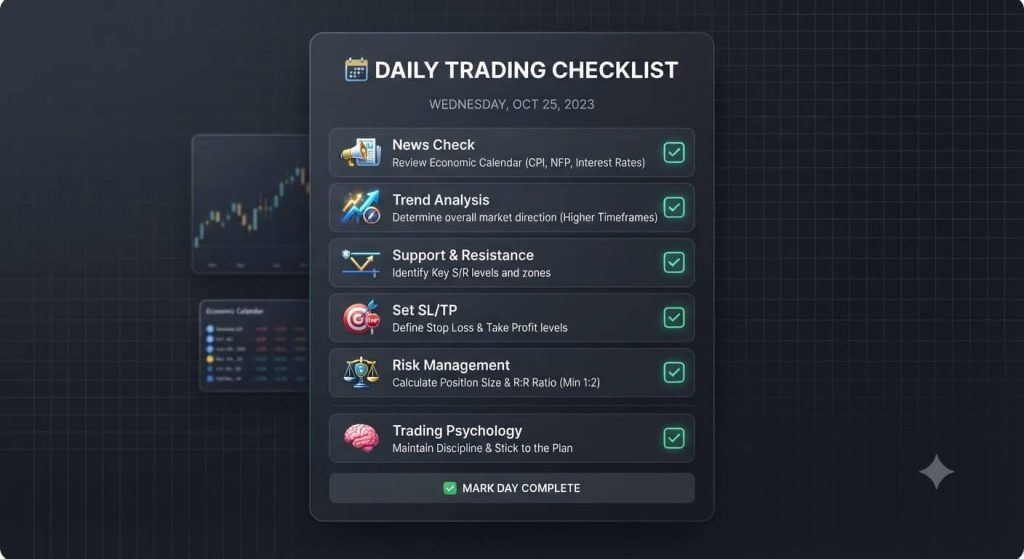
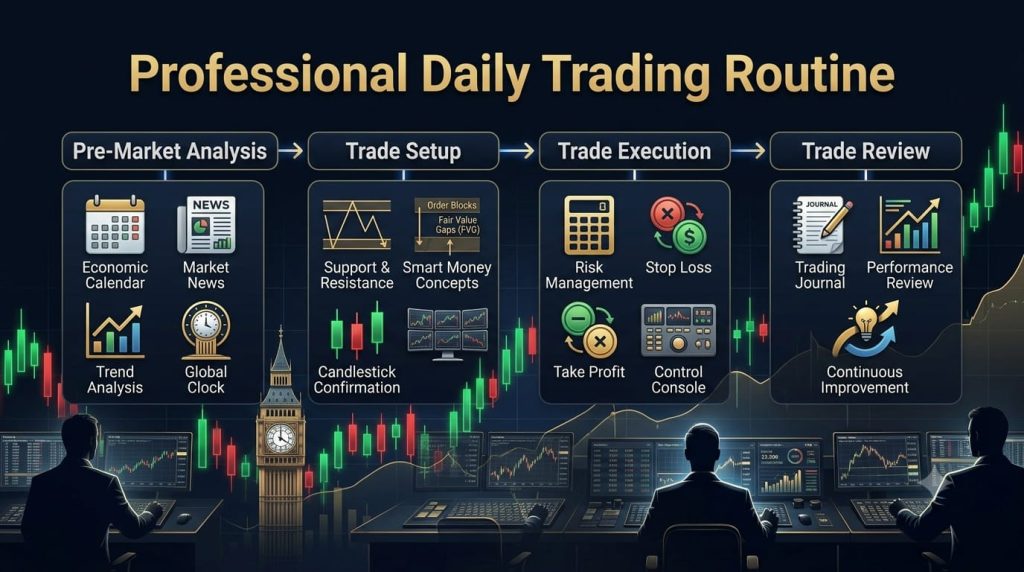
📅 DAILY TRADING ROUTINE
🎯 Purpose: Follow a consistent daily routine to improve discipline and trading performance.
🌅 Before the Market Opens
- ✅ Check the Economic Calendar.
- ✅ Review major overnight news.
- ✅ Check the US Dollar Index (DXY).
- ✅ Analyze Gold (XAUUSD) if trading Gold.
- ✅ Mark Daily & Weekly Support and Resistance.
- ✅ Draw Trendlines and Liquidity Zones.
- ✅ Identify the Higher Timeframe Trend.
- ✅ Mark Order Blocks & Fair Value Gaps.
📊 Before Entering a Trade trading plan.
- ✅ Trend confirmed.
- ✅ Market Structure confirmed.
- ✅ Support/Resistance confirmed.
- ✅ Liquidity sweep completed
- ✅ Candlestick confirmation.
- ✅ Stop Loss placed.
- ✅ Risk-to-Reward at least 1:2
- ✅ Position size calculated.
- ✅ No major news approaching.
📈 During the Trade
- ✔️ Follow your trading plan.
- ✔️ Do not move Stop Loss emotionally.
- ✔️ Avoid closing trades too early.
- ✔️ Let your strategy work.
📖 After the Trade
- ✅ Take a screenshot.
- ✅ Record entry & exit.
- ✅ Write why you entered.
- ✅ Record emotions.
- ✅ Improve your strategy.
⚖️ RISK-TO-REWARD RATIO (R:R)
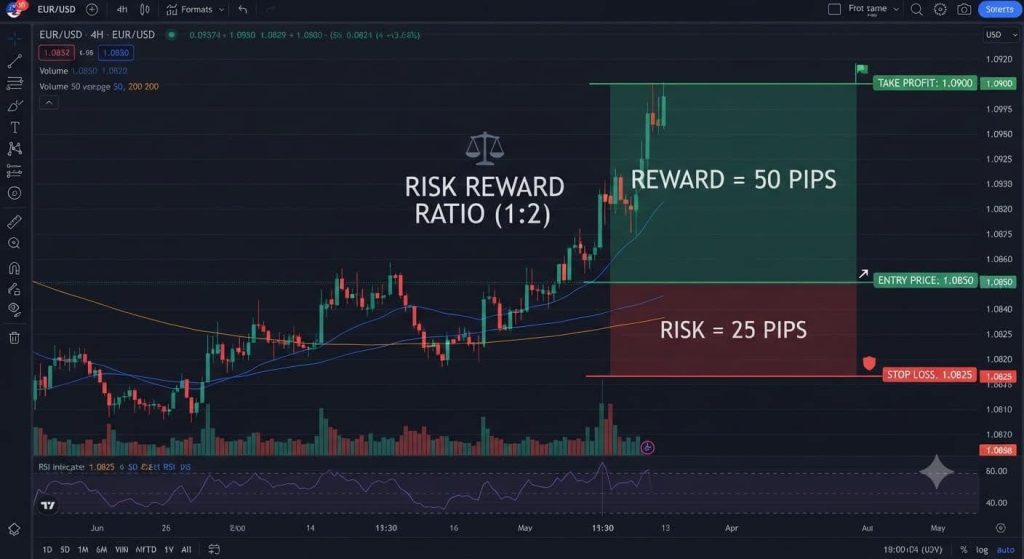
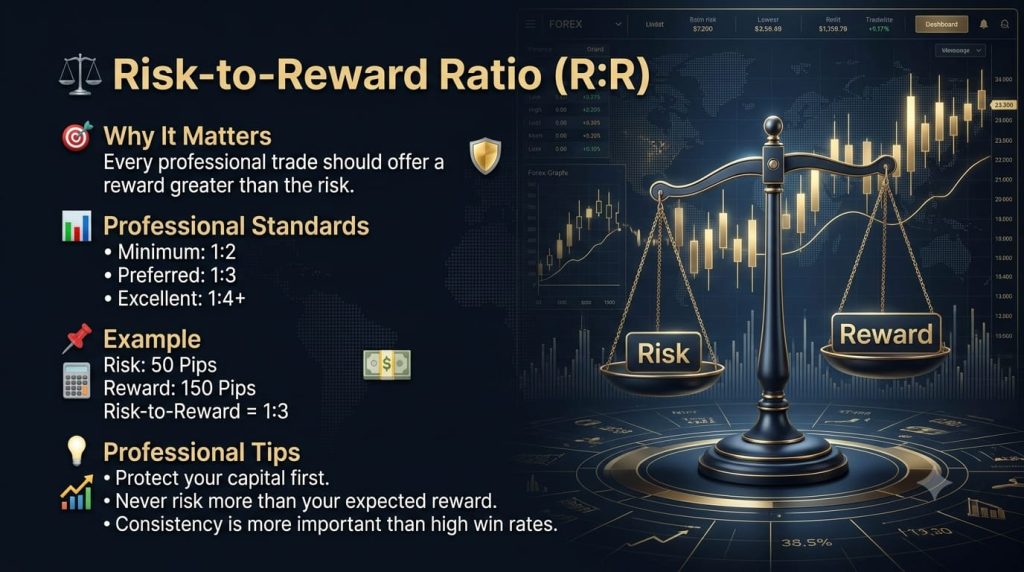
🎯 Purpose: Ensure your potential reward is worth the risk before entering a trade.
📊 Professional Standards
- ✅ Minimum → 1:2
- ✅ Preferred → 1:3
- ✅ Excellent → 1:4 or higher
- 📌 Example 1 Risk = 30 pips Reward = 60 pips Risk-to-Reward = 1:2
- 📌 Example 2 Risk = 50 pips Reward = 150 pips Risk-to-Reward = 1:3
📌 Benefits
- ✔️ You don't need to win every trade.
- ✔️ A good Risk-to-Reward ratio can keep you profitable even with a moderate win rate.
- ✔️ Protects your account from large drawdowns.
💡 Professional Tips
- ✔️ Never risk more than your planned reward.
- ✔️ Avoid trades with poor Risk-to-Reward.
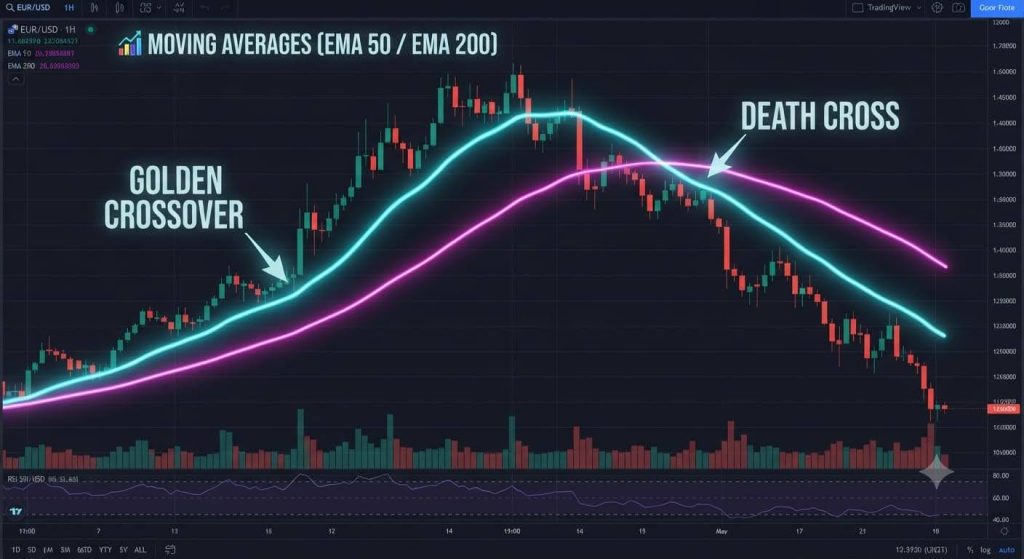
📊 MOVING AVERAGES (TREND FILTER)
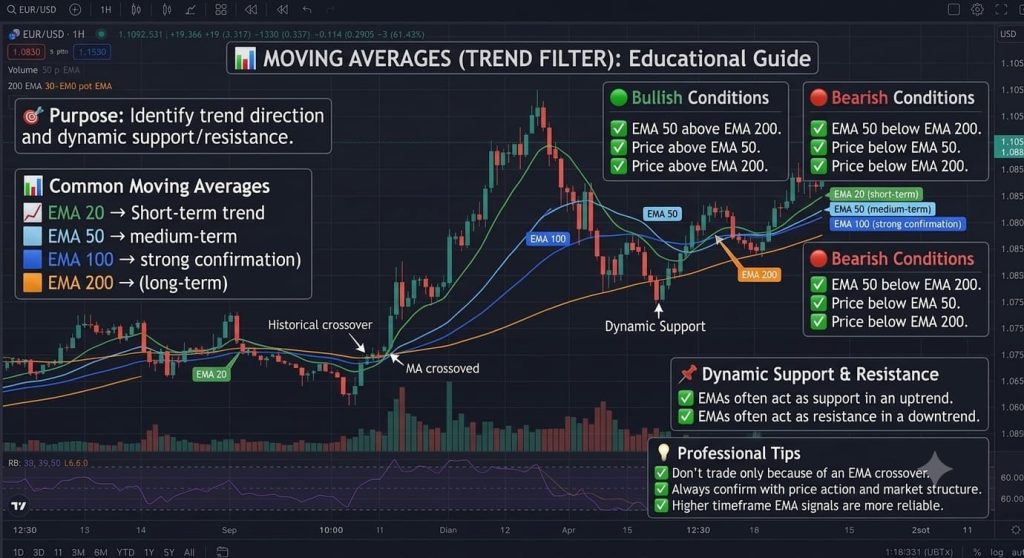
🎯 Purpose: Identify trend direction and dynamic support/resistance.
📍 Common Moving Averages 📈 EMA 20 → Short-term trend. 📈 EMA 50 → Medium-term trend. 📈 EMA 100 → Strong trend confirmation. 📈 EMA 200 → Long-term market direction.
🟢 Bullish Conditions
- EMA 50 above EMA
- EMA 50 above EMA 200.
- Price above EMA 50.
- Price above EMA 200.
🔴 Bearish Conditions
📌 Benefits
- EMA 50 below EMA 200.
- Price below EMA 50.
- Price below EMA 200.
📌 Dynamic Support & Resistance
- EMAs often act as support in an uptrend.
- EMAs often act as resistance in a downtrend.
💡 Professional Tips
- EMAs often act as support in an uptrend.
- EMAs often act as resistance in a downtrend.
- Don't trade only because of an EMA crossover.
- Always confirm with price action and market structure.
- Higher timeframe EMA signals are more reliable.
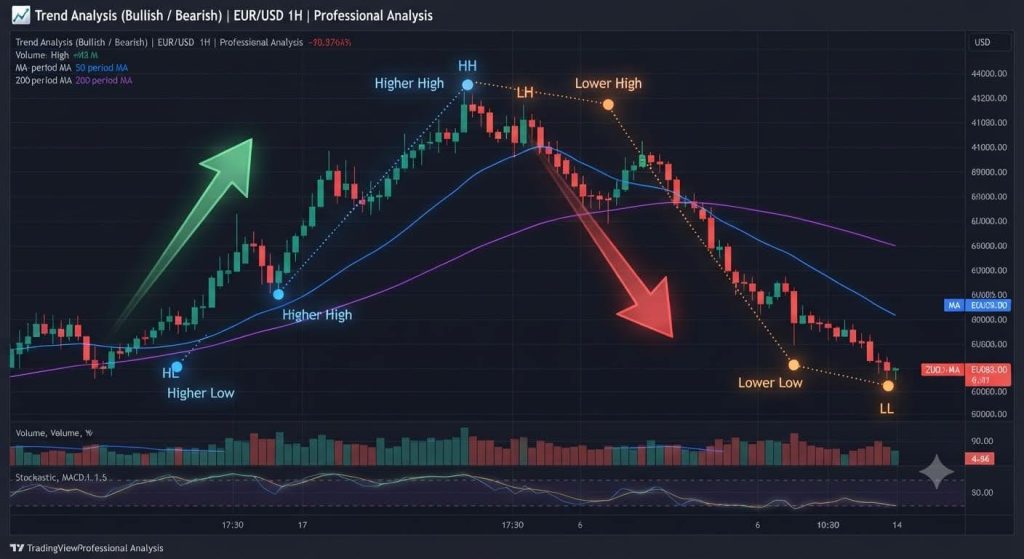
📈 MARKET TREND ANALYSIS
🎯 Purpose: Identify the overall market direction before entering any trade. The trend is the foundation of successful trading.
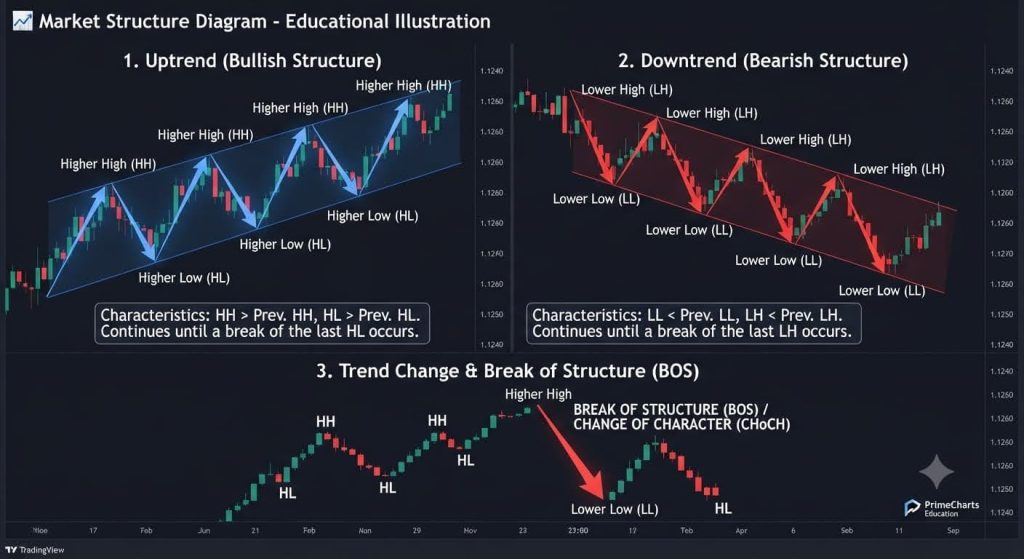
🟢 Bullish Trend (Uptrend)
- ✅ Higher Highs (HH)
- ✅ Higher Lows (HL)
- ✅ Buyers are in full control.
- ✅ Look only for BUY opportunities.
- ✅ Buy after pullbacks to support or demand zones.
- ✅ Avoid selling against a strong uptrend.
🔴 Bearish Trend (Downtrend)
- ✅Lower Highs (LH)
- ✅ Lower Lows (LL)
- ✅ Sellers dominate the market.
- ✅ Look only for SELL opportunities
- ✅ Sell after pullbacks to resistance or supply zones.
- ✅ Avoid buying against a strong downtrend.
🟡 Ranging Market 🔸 Price moves between Support and Resistance. 🔸 No clear trend direction. 🔸 Buy near Support. 🔸 Sell near Resistance. 🔸 Avoid trading in the middle of the range. 🔸 Wait for a confirmed breakout before following a new trend.
💡 Professional Tips
- Always trade with the trend.
- Higher timeframe trends (4H/Daily) are stronger than lower timeframes.
- Strong trends usually provide higher-probability set
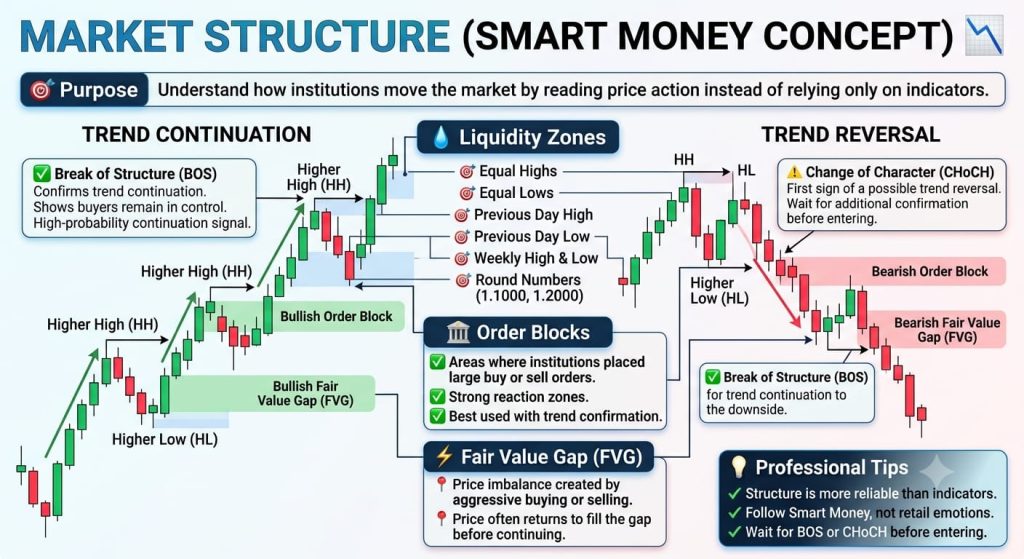
MARKET STRUCTURE (SMART MONEY CONCEPT)
🎯 Purpose: Understand how institutions move the market by reading price action instead of relying only on indicators.
🔹 Break of Structure (BOS)
- ✅ Confirms trend continuation.
- ✅ Shows buyers or sellers remain in control.
- ✅ High-probability continuation signal.
🔄 Change of Character (CHoCH) ⚠️ First sign of a possible trend reversal. ⚠️ Wait for additional confirmation before entering.
💧 Liquidity Zones 🎯 Equal Highs 🎯 Equal Lows 🎯 Previous Day High 🎯 Previous Day Low 🎯 Weekly High & Low 🎯 Round Numbers (1.1000, 1.2000)
🏦 Order Blocks
- Areas where institutions placed large buy or sell orders.
- Strong reaction zones.
- Best used with trend confirmation.
⚡ Fair Value Gap (FVG) 📍 Price imbalance created by aggressive buying or selling. 📍 Price often returns to fill the gap before continuing.
💡 Professional Tips
- Structure is more reliable than indicators.
- Follow Smart Money, not retail emotions.
- Wait for BOS or CHoCH before entering
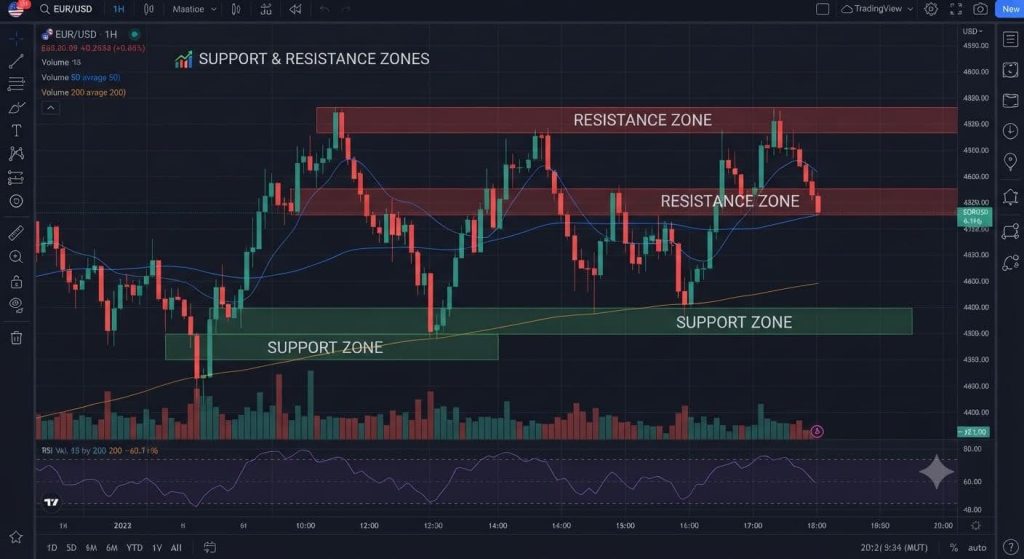
📍SUPPORT & RESISTANCE
🎯 Purpose: Identify key areas where price is likely to reverse, bounce, or break.
🟢 Support (Demand Zone):
- Buyers previously entered the market.
- Price may bounce upward.
- Strong buying interest.
🔴 Resistance (Supply Zone) :
- Sellers previously entered the market.
- Price may reverse downward.
- Strong selling interest.
📌 How to Draw Correctly
- Use zones instead of single lines
- Mark multiple price reactions.
- Higher timeframe zones are stronger.
- Combine with trend and candlestick confirmation.
💡 Professional Tips
- ✔️ Buy only near strong support.
- ✔️ Sell only near strong resistance.
- ✔️ Never enter in the middle of nowhere.
- ✔️ Wait for confirmation before placing any trade.
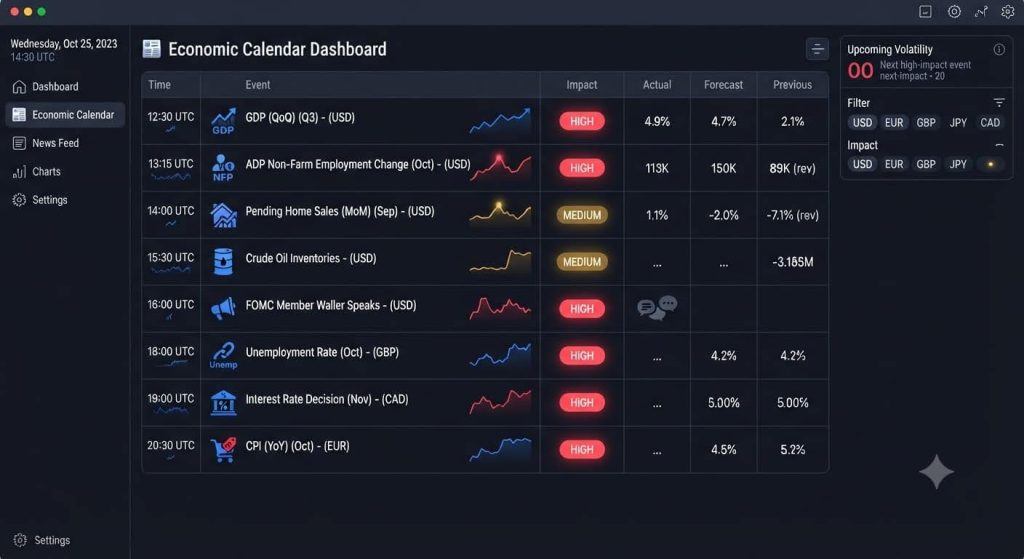
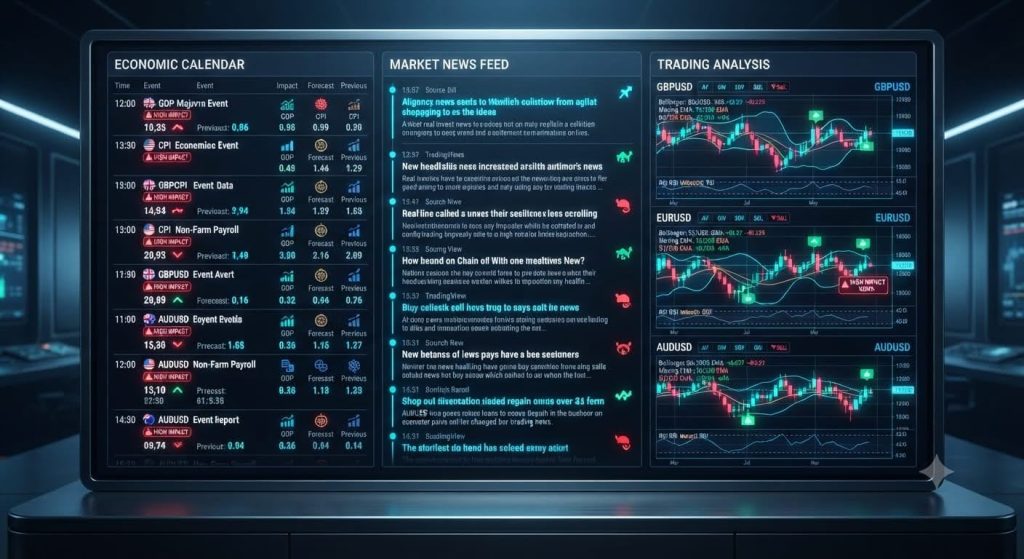
📰 ECONOMIC CALENDAR & FUNDAMENTAL ANALYSIS
🎯 Purpose: Understand how major economic events influence the Forex market.
🔥 High-Impact News
📊 Non-Farm Payroll (NFP)
💰 Consumer Price Index (CPI) 🏦 Interest Rate Decisions
📢 FOMC Meetings
📈 GDP Reports
👥 Unemployment Rate
🛒 Retail Sales 🏭 PMI Reports
⚠️ During High-Impact News
❌ Volatility increases.
❌ Spread becomes wider.
❌ Slippage may occur.
❌ Fake breakouts become more common.
💡 Professional Tips
- ✔️ Always check the economic calendar before trading.
- ✔️Avoid opening new trades just before major news.
- ✔️Wait for market volatility to settle after news releases.
- ✔️News can change the market direction instantly.
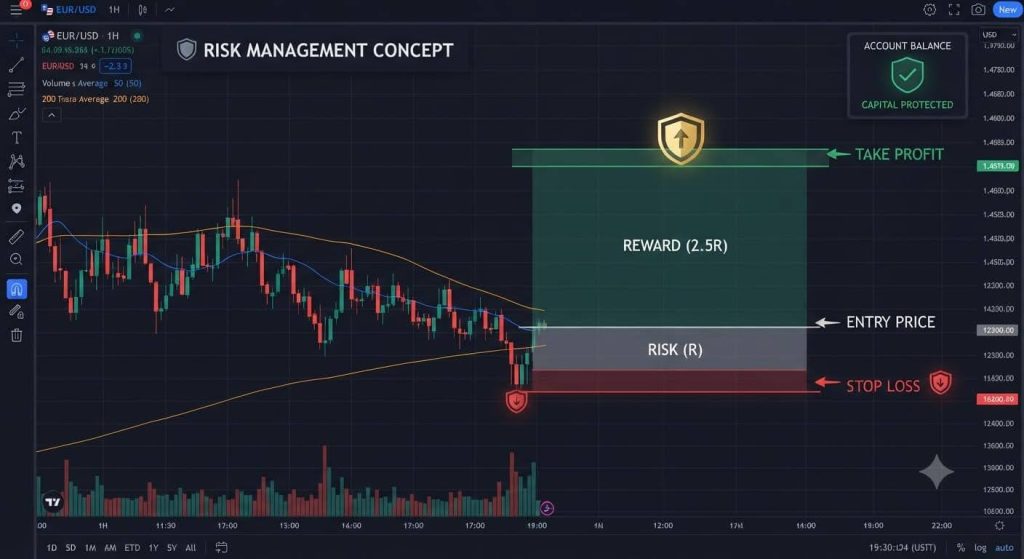
💰 RISK MANAGEMENT
🎯 Purpose: Protect your trading capital and survive long enough to become consistently profitable.
🟢🛡️ Risk Rules:
✅ Risk only 1–2% of your account on a single trade.
✅ Always place a Stop Loss (SL). ✅ Calculate your lot size before entering.
✅ Never move your Stop Loss further away to avoid a loss.
✅ Don’t risk more than you can afford to lose.
- 📉 Losing Streak Management
🔸 Accept losses as part of trading.
🔸 Reduce lot size after several consecutive losses.
🔸 Review your mistakes instead of chasing losses.
🔸 Stay disciplined and follow your trading plan.
💡 Professional Tips
- ✔️ Capital preservation comes first.
- ✔️Small losses are normal.
- ✔️One bad trade should never damage your account.
- ✔️Consistency beats taking unnecessary risks.
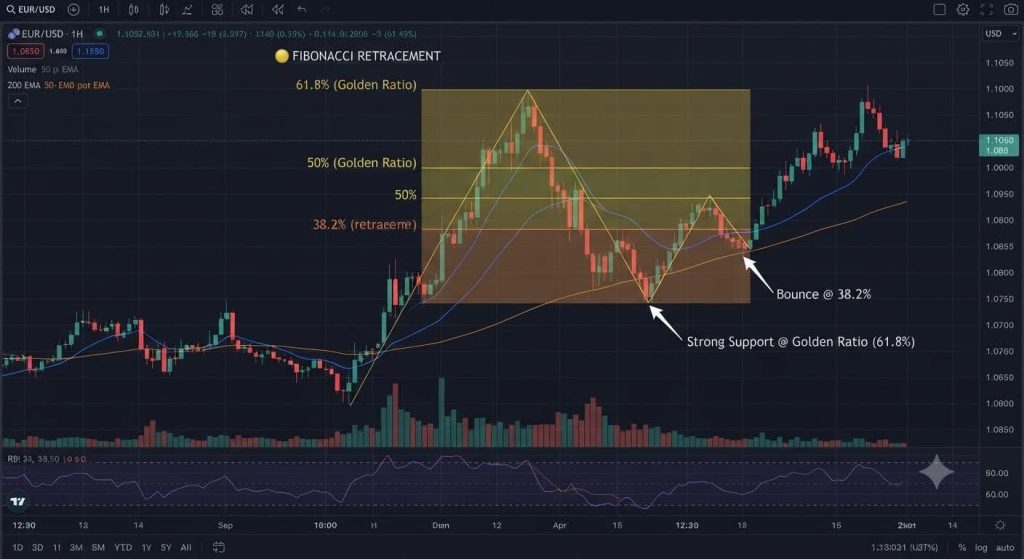
FIBONACCI RETRACEMENT
🎯 Purpose: Find high-probability pullback entries within an existing trend.
🟢📊 Key Fibonacci Levels:
🔹 23.6% → Very shallow pullback.
🔹 38.2% → Healthy retracement.
🔹 50.0% → Strong pullback area.
🔹 61.8% → Golden Ratio (High-probability reversal). 🔹 78.6% → Deep retracement.
- Bullish Trend
✅ Draw Fibonacci from Swing Low to Swing High.
✅ Look for BUY opportunities at key levels.
- 📉 Bearish Trend
✅ Draw Fibonacci from Swing High to Swing Low.
✅ Look for SELL opportunities at key levels.
💡 Professional Tips
- ✔️ Never use Fibonacci alone
- ✔️Combine with Support & Resistance.
- ✔️Combine with Market Structure.
- ✔️ Wait for candlestick confirmation.
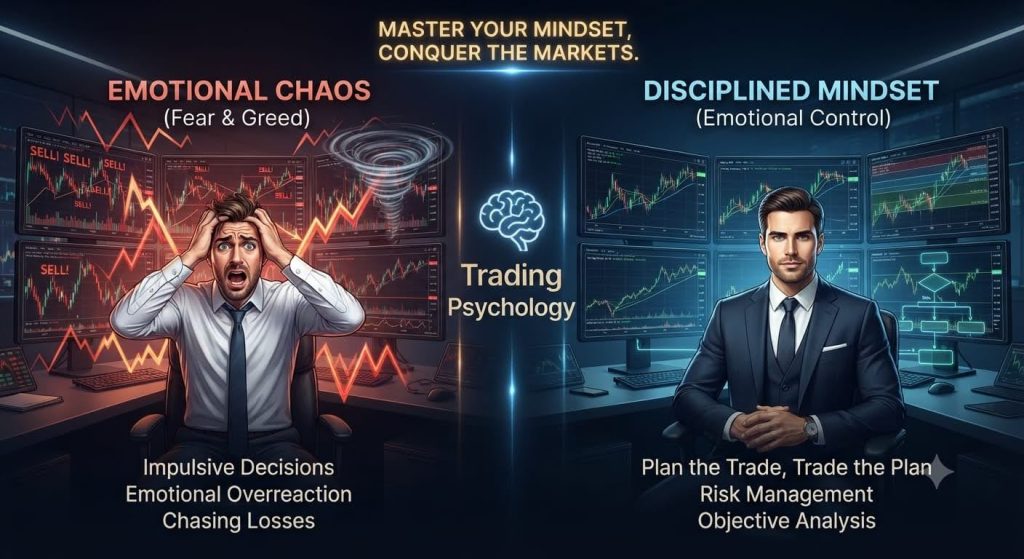
🧠 TRADING PSYCHOLOGY
🎯 Purpose: Control emotions and maintain discipline, because mindset is just as important as strategy.
🟢😨 Fear:
❌ Closing profitable trades too early.
❌ Hesitating to take valid setups.
💰 Greed
❌ Holding trades for unrealistic profits.
❌ Increasing lot size without a plan.
🔥 Revenge Trading
❌ Trying to recover losses immediately.
❌ Taking random trades after losing.
- 🚀 FOMO (Fear of Missing Out)
❌ Chasing price after a move has already happened.
❌ Entering late without confirmation.
🧘 Professional Mindset
- ✔️ Follow your trading plan.
- ✔️ Accept losses as part of the process.
- ✔️ Stay patient and disciplined.
- ✔️ Focus on long-term consistency.
- ✔️ Quality trades are better than many trades.
🧘 Professional tips
- ✔️ Control your emotions before placing any trade.
- ✔️ Never let one winning or losing trade affect your next decision.
- ✔️ Successful traders think in probabilities, not certainties.
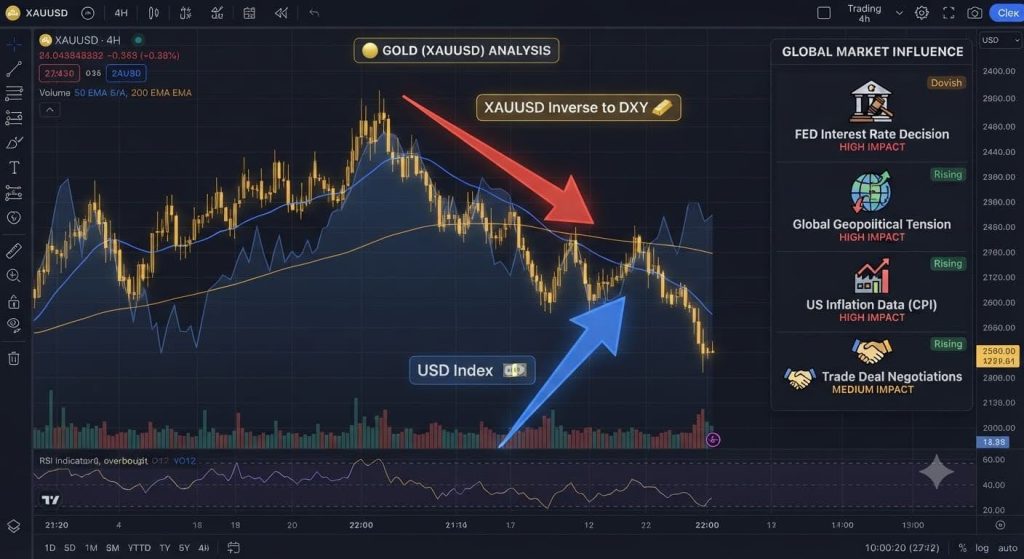
🟡 GOLD (XAUUSD) ANALYSIS
🎯 Purpose: Understand the main factors that influence Gold prices and identify high-probability trading opportunities.
📊 Gold Usually Rises When
✅ US Dollar weakens.
✅ Inflation increases.
✅ Interest rates decrease.
✅ Geopolitical tensions increase.
✅ Investors seek safe-haven assets.
✅ Global economic uncertainty grows.
📉 Gold Usually Falls When
❌ US Dollar strengthens.
❌ Interest rates increase.
❌ Inflation decreases.
❌ Risk appetite improves.
❌ Stock markets perform strongly.
🔍 Key Factors to Monitor
🏦 Federal Reserve (Fed) decisions.
💵 US Dollar Index (DXY).
📈 CPI (Inflation Data).
👥 NFP (Employment Report).
🌍 Wars & geopolitical conflicts.
🏛️ Central Bank gold purchases.
🧘 Professional tips
- ✔️ Gold is highly volatile.
- ✔️ Avoid overleveraging.
- ✔️ Use wider Stop Loss based on market volatility.
- ✔️ Always check the economic calendar before trading Gold.
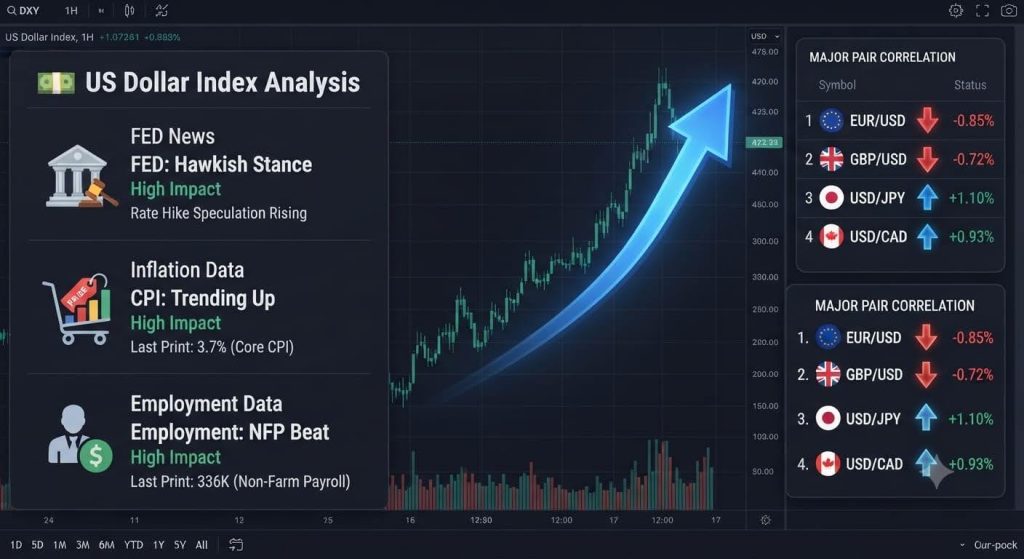
💵 US DOLLAR STRENGTH ANALYSIS
🎯 Purpose: Control emotions and maintain discipline, because mindset is just as important as strategy.
📊 Main Drivers of USD
🏦 Federal Reserve Interest Rate Decisions.
📈 Consumer Price Index (CPI). 👥 Non-Farm Payroll (NFP).
📉 Unemployment Rate.
📊 GDP Growth.
🛒 Retail Sales.
🏭 PMI Reports.
🗣️ FOMC Speeches.
📈 US Dollar Strength (Bullish USD
✅ EURUSD usually falls.
✅ GBPUSD usually falls.
✅ AUDUSD usually falls.
✅ NZDUSD usually falls.
✅ Gold often falls.
📉 US Dollar Weakness (Bearish USD
✅ EURUSD usually rises.
✅ GBPUSD usually rises.
✅ AUDUSD usually rises.
✅ NZDUSD usually rises
✅ Gold often rises.
📌 Monitor the DXY (US Dollar Index)
📈 Rising DXY = Stronger USD.
📉 Falling DXY = Weaker USD.
🧘 Professional tips
- ✔️ Never trade USD pairs without checking major US news.
- ✔️ Strong USD can impact almost every major currency pair
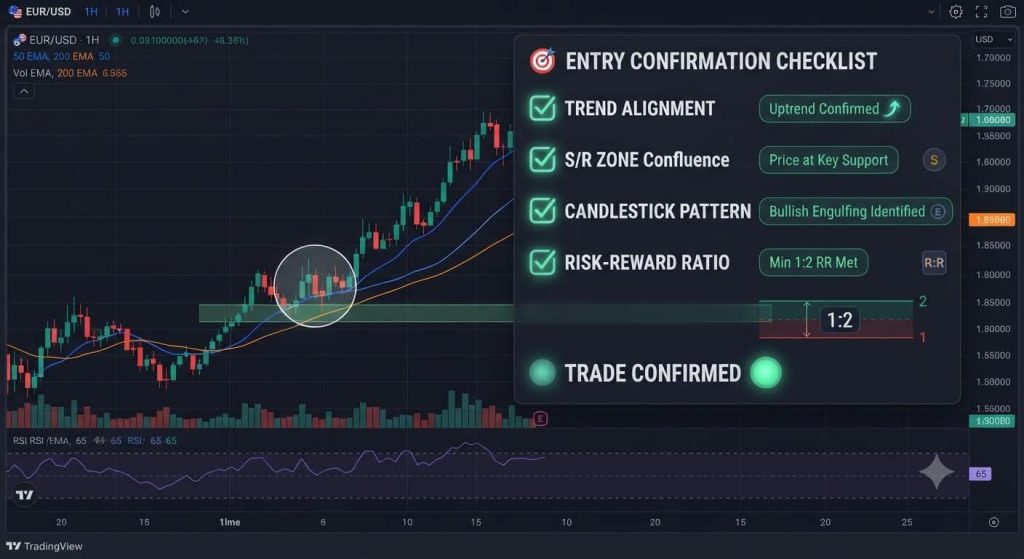
🎯 ENTRY CONFIRMATION CHECKLIST
🎯 Purpose: Confirm every condition before entering a trade to improve consistency.
✅ Trend direction confirmed.
✅ Higher timeframe agrees with the trade.
✅ Market Structure (BOS/CHoCH) confirmed.
✅ Support or Resistance identified.
✅ Liquidity sweep completed (if applicable).
✅ Candlestick confirmation present.
✅ Fibonacci level supports the setup.
✅ Moving Averages confirm the trend.
✅ No major high-impact news approaching.
✅ Stop Loss placed correctly. ✅ Take Profit planned.
✅ Risk-to-Reward is at least 1:2.
✅ Position size calculated.
✅ Trade follows your trading plan.
🚫 If any important confirmation is missing, wait for a better setup.
🧘 Professional tips
- ✔️ Patience is a trading skill.
- ✔️ A missed trade is better than a bad trade
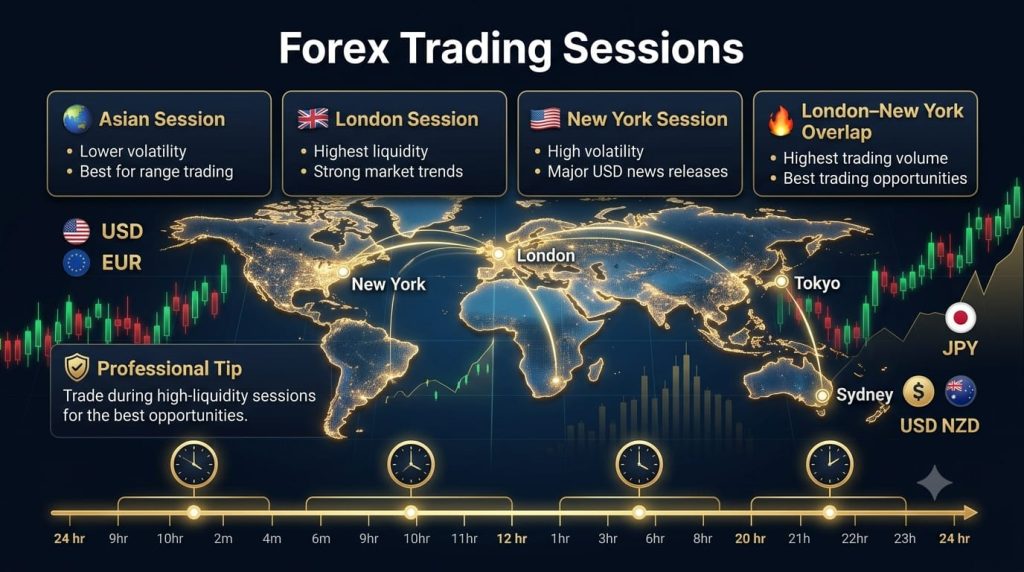
TRADING SESSIONS
🎯 Purpose: Trade during the most active market hours for better liquidity and price movement.
🌏 Asian Session
🕒 Lower volatility.
🕒 Smaller price movements. 🕒 Best for range-bound strategies.
🕒 Major pairs: JPY, AUD, NZD.
🇬🇧 London Session
🕒 Highest liquidity.
🕒 Strong trends and breakouts.
🕒 Large institutional participation.
🕒 Excellent for Forex trading.
🇺🇸 New York Session
🕒 High volatility.
🕒 Major US economic news releases.
🕒 Strong price movements in USD pairs and Gold.
🔥 London + New York Overlap
⭐ Highest trading volume.
⭐ Strongest momentum. ⭐ Best time for day traders and scalpers.
⭐ Often produces the largest moves of the day.
🧘 Professional tips
- ✔️ Trade when liquidity is highest.
- ✔️Avoid low-volume periods unless your strategy is designed for them.
- ✔️ Always know which session you're trading in.
TRADING SESSIONS
🎯 Purpose: Trade during the most active market hours for better liquidity and price movement.
🌏 Asian Session
🕒 Lower volatility.
🕒 Smaller price movements. 🕒 Best for range-bound strategies.
🕒 Major pairs: JPY, AUD, NZD.
🇬🇧 London Session
🕒 Highest liquidity.
🕒 Strong trends and breakouts.
🕒 Large institutional participation.
🕒 Excellent for Forex trading.
🇺🇸 New York Session
🕒 High volatility.
🕒 Major US economic news releases.
🕒 Strong price movements in USD pairs and Gold.
🔥 London + New York Overlap
⭐ Highest trading volume.
⭐ Strongest momentum. ⭐ Best time for day traders and scalpers.
⭐ Often produces the largest moves of the day.
🧘 Professional tips
- ✔️ Trade when liquidity is highest.
- ✔️Avoid low-volume periods unless your strategy is designed for them.
- ✔️ Always know which session you're trading in.
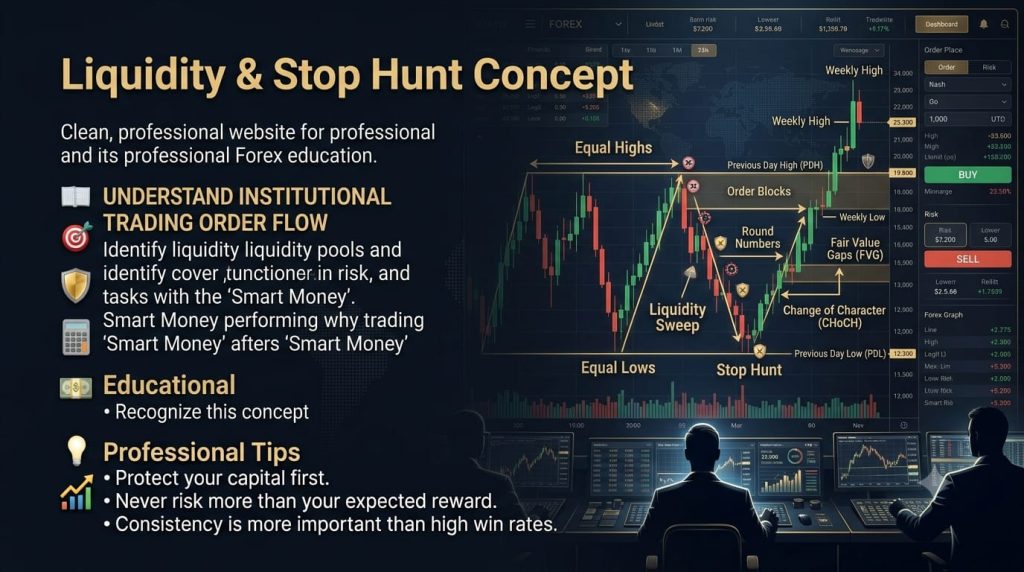
🔥LIQUIDITY & STOP HUNT CONCEPT
🎯 Purpose: Trade during the most active market hours for better liquidity and price movement.
💧 What is Liquidity?
✅ Liquidity is where a large number of Buy Stops and Sell Stops are placed.
✅ Smart Money targets these areas before making the real market move.
✅ Retail traders often place stop losses in obvious locations, making them liquidity targets.
Common Liquidity Areas
📍 Equal Highs
📍 Equal Lows
📍 Previous Day High (PDH)
📍 Previous Day Low (PDL)
📍 Weekly High & Weekly Low
📍 Monthly High & Monthly Low
📍 Round Numbers (1.1000, 1.2000, 1.3000)
📍 Trendline Stops
📍 Swing Highs & Swing Lows
🚨 Stop Hunt
❌ Price may briefly break above Resistance or below Support to trigger stop losses before reversing.
❌ Many false breakouts are actually liquidity grabs.
🧘 Professional tips
- ✔️ Never enter immediately after a breakout.
- ✔️ Wait for liquidity to be taken first.
- ✔️ Look for BOS or CHoCH after a liquidity sweep.
- ✔️ Combine Liquidity with Market Structure, Order Blocks and Candlestick Confirmation.
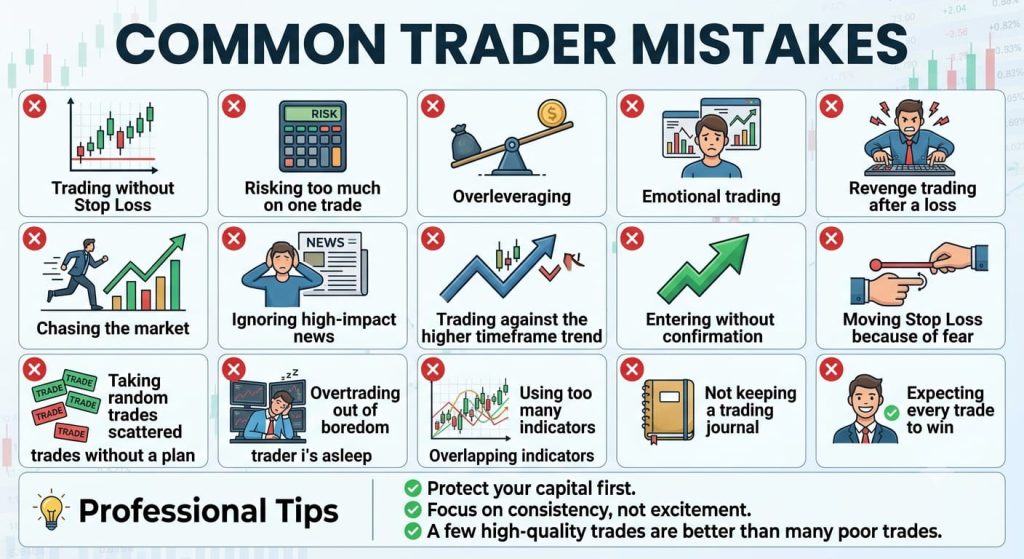
🚨 COMMON TRADER MISTAKES
❌ Trading without Stop Loss.
❌ Risking too much on one trade.
❌ Overleveraging.
❌ Emotional trading.
❌ Revenge trading after a loss.
❌ Chasing the market.
❌ Ignoring high-impact news.
❌ Trading against the higher timeframe trend.
❌ Entering without confirmation.
❌ Moving Stop Loss because of fear.
❌ Taking random trades without a plan.
❌ Overtrading out of boredom.
❌ Using too many indicators.
❌ Not keeping a trading journal.
❌ Expecting every trade to win.
🧘 Professional tips
- ✔️ Protect your capital first.
- ✔️ Focus on consistency, not excitement.
- ✔️ A few high-quality trades are better than many poor trades.
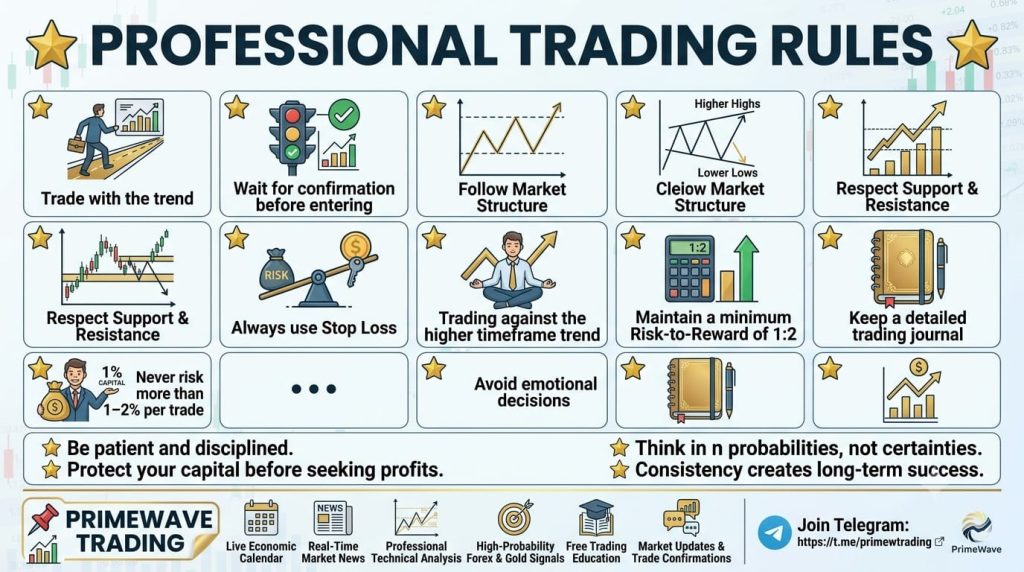
🏆 PROFESSIONAL TRADING RULES
⭐ Trade with the trend.
⭐ Wait for confirmation before entering.
⭐ Follow Market Structure.
⭐ Respect Support & Resistance.
⭐ Always use Stop Loss.
⭐ Maintain a minimum Risk-to-Reward of 1:2.
⭐ Never risk more than 1–2% per trade.
⭐ Avoid emotional decisions.
⭐ Keep a detailed trading journal.
⭐ Be patient and disciplined.
⭐ Protect your capital before seeking profits.
⭐ Think in probabilities, not certainties.
⭐ Consistency creates long-term success.
📌 PRIMEWAVE TRADING
- 📊 Daily Market Analysis
- 📉 Professional Technical Analysis
- 🎯 High-Probability Forex & Gold Signals
- 📚 Free Trading Education
- 💬 Market Updates & Trade Confirmations
